Every year on May 12 – the birthday of Maryam Mirzakhani, the first woman ever to receive the Fields Medal – the global mathematical community comes together to celebrate the International Day of Women in Mathematics. It started in 2018 at the World Meeting for Women in Mathematics in Rio de Janeiro, and it has been growing ever since.
Here at Comics&Science, we’ve been following and supporting this initiative for years. We dedicated two issues of our series to women in mathematics: The Women in Math Issue, telling the story of Sofia Kovalevskaja, and The Mirzakhani Issue, a tribute to Maryam Mirzakhani herself. Because we believe that celebrating women in mathematics matters – and that stories are one of the most powerful ways to do it.
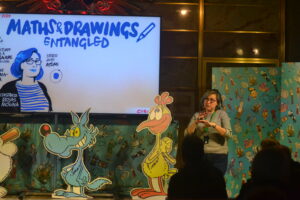
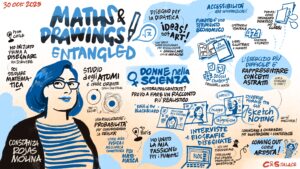
So when we started thinking about how to mark this year’s May 12 the name of Constanza Rojas-Molina came immediately to our minds. We already had the pleasure of hosting her last October at the Comics&Science PALACE in Lucca, where she gave a talk called “Maths & Drawings, Entangled“.
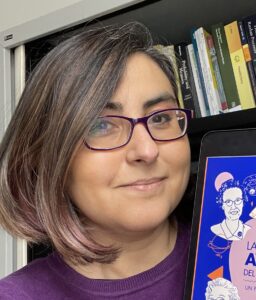
Constanza is a mathematician working on quantum disordered systems at CY Cergy Paris University, but she is also a published illustrator and comic author who has spent years exploring how drawing – comics, sketchnotes, social media challenges – can open doors to science and make room for voices that too often go unheard. If you’ve come across the #Noethember challenge on social media, or the comic La misteriosa conjetura de Alicia, or the blog The RAGE of the Blackboard where she interviews female scientists about the real, unfiltered experience of life in academia – that’s her.
Her path from Chile to France, from physics to mathematics, from sketchbook doodles to published comics, is a story of curiosity, stubbornness, and the deep conviction that mathematics and art are not separate worlds. We asked her about all of this – and about what it means, today, to be a woman in mathematics.
About Comics&Science
Comics&Science is a science communication project and publication series by CNR Edizioni – the publishing outlet of Italy’s National Research Council (CNR). Founded in 2012 within the cultural programme of the Lucca Comics & Games festival, Comics&Science commissions original comics by leading Italian authors and pairs them with scientific editorials curated by the CNR research community. The aim is to promote the relationship between science and entertainment, in the conviction that both are essential to personal and civic growth. Since its launch, the project has produced dozens of thematic issues – from mathematics to biodiversity, from the internet to Earth observation – and has expanded into events and workshops.
About Constanza Rojas-Molina
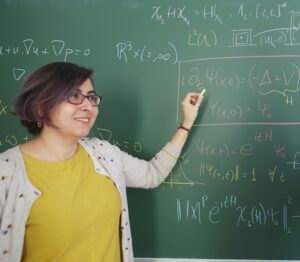
Constanza (Coni) Rojas-Molina is Associate Professor at the Mathematics Department at CY Cergy Paris University. A mathematician and professional illustrator, her activities include teaching, research, science communication, and illustration.
Coni’s research focuses on mathematical models of quantum physics, using the theory of differential operators and probabilities to study the behaviour of electrons in materials with impurities. She is Associate Editor for the Journal of Mathematical Physics and a member of the Association of Women in Mathematical Physics.
She uses illustration, sketchnotes, and comics as tools for scientific communication. In 2023, she published in Chile, her country of origin, the book La gran aventura del conocimiento: un paseo con las matemáticas en cuatro estaciones (Ed. Planeta) with Leslie Jiménez Palma, a mathematician and education specialist. In 2024 she published in Chile the comic La misteriosa conjetura de Alicia, together with mathematician and writer Alberto Mercado, which was later published also in French.
Coni is a member of the Outreach and Public Engagement Committee of the European Mathematical Society, and her work has been recognised by several mathematical societies in Europe and abroad. In 2024, she received the Prize for Scientific Mediation at CY Cergy Paris University, and in 2025 she obtained a diploma in Innovative Scientific Communication from the Paris Cité University.
She is also the creator of #Noethember, a drawing challenge dedicated to the life of mathematician Emmy Noether, and the author of the blog The RAGE of the Blackboard, where she interviews female scientists and reflects on life in academia.
The International Day of Women in Mathematics is a moment to reflect on representation. How has your own experience been as a woman navigating the world of mathematics – from your early studies in Chile to your current position in France? And were there role models or key figures along the way who were decisive in shaping your journey?
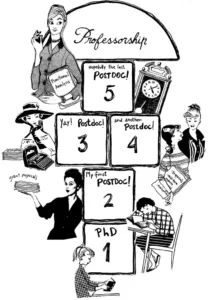
It wasn’t until I started my first postdoc that I became conscious about the representativity problem the discipline has. While doing my degree in mathematics at my hometown’s public university, in the province, in Chile, I wasn’t conscious about this problem, although I was always one of the few women in the classroom. Then, when I moved to France to pursue my master and PhD, it was a moment where there were quite a few women doing their PhDs together with me, so once again, I didn’t see it. Until I went for a postdoc in Germany, where then I was sometimes the only woman in the room, and there were virtually no female professors, that I became truly conscious about this problem, because it became a problem for me. I felt uncomfortable, I felt alone.
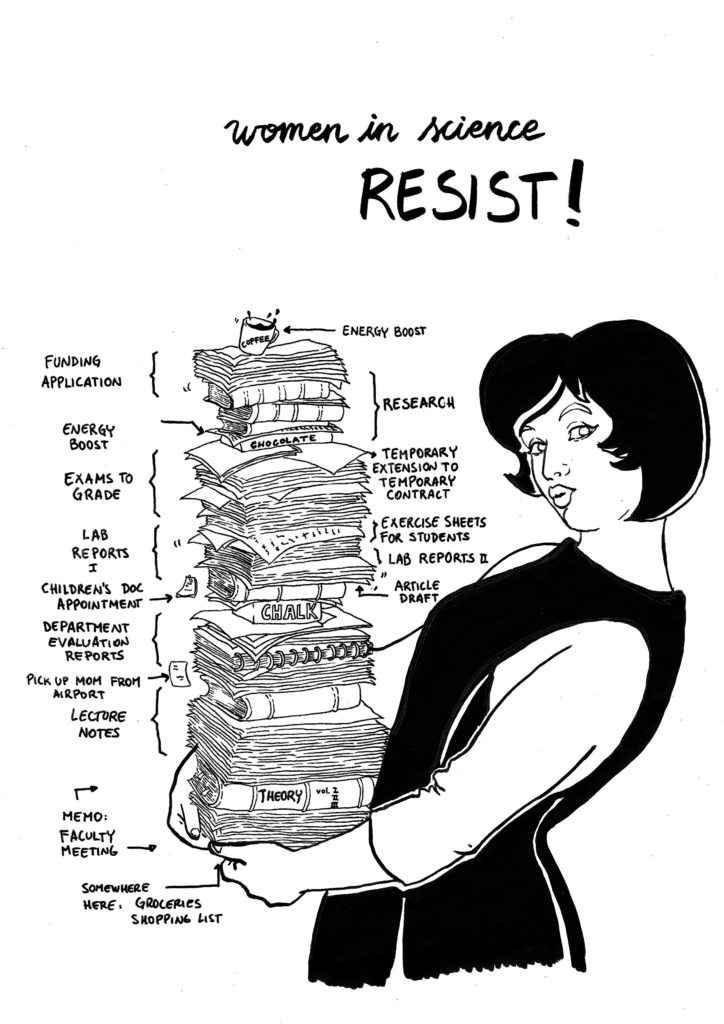
The problem manifest in the following way: as you go up the ladder of the professional career in mathematics, women dissapear. What I mean by “the problem” is: the academic environment is designed to push women away, but not only women, but diversty of any kind. Back then, this had a negative impact on me, because I was at a moment in my career where I needed to interact with people like me, in the sense of my diversity (women, immigrant, away from my partner and family, with creative interests, etc.) and then I realized that actually this problem was present throughout my whole education, but I had internalized it to such degree that I didn’t see it anymore. I mention how my view evolved, because this shows that unless you see it by yourself or you are negatively impacted by it yourself, it’s hard ot believe it. Even today, many male colleagues do not see a problem, or they think it is exagerated, and the International Day of Women in Mathematics is precisely a day to talk about this and to raise awareness to this problem, that is, to show those who don’t see it and are not negatively impacted by it, that this issue exists and have a negative effect on many lives, pushing them away from this career, which they have a right to. Everyone has a right to pursue this path.
As you can imagine, at that moment of awareness, I became militant for equal opportunities for women in mathematics and in science in general. I stayed in academia because I was lucky enought to have the support of my family and my peers. I had role models, indeed. I had mentors (male and female) who, by giving the example, showed me that one could have a fulfilling career in mathematics without following the standard career path. People that were kind and empathic. They never said “look at me, I’m a role model, I’m an example to follow”, of course. But that’s what role models are, they are just people that reflect your own values, who hold a position of authority that you aspire to. You want kindness, they are kind, you want a permanent position, they have a permanent position, you want to do good maths, they do excellent maths, you want generosity, they are generous. They show you there is a way to do maths that agrees with your principles, so they are an inspiration. And I had them at every stage of my career. In several moments they gave me a key advice, or had a gesture toward me, that, without them knowing it, allowed me to stay in academia, and have a career I’m proud of, and I’m forever grateful to them for that.
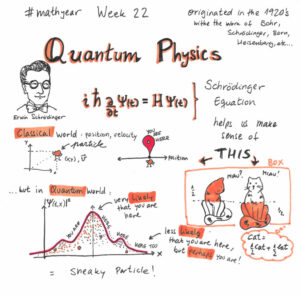 You’re a mathematician working on quantum disordered systems and a published illustrator and comic author. How did these two sides of your identity come together? Was there a specific moment when you realised drawing could become part of your professional life as a researcher?
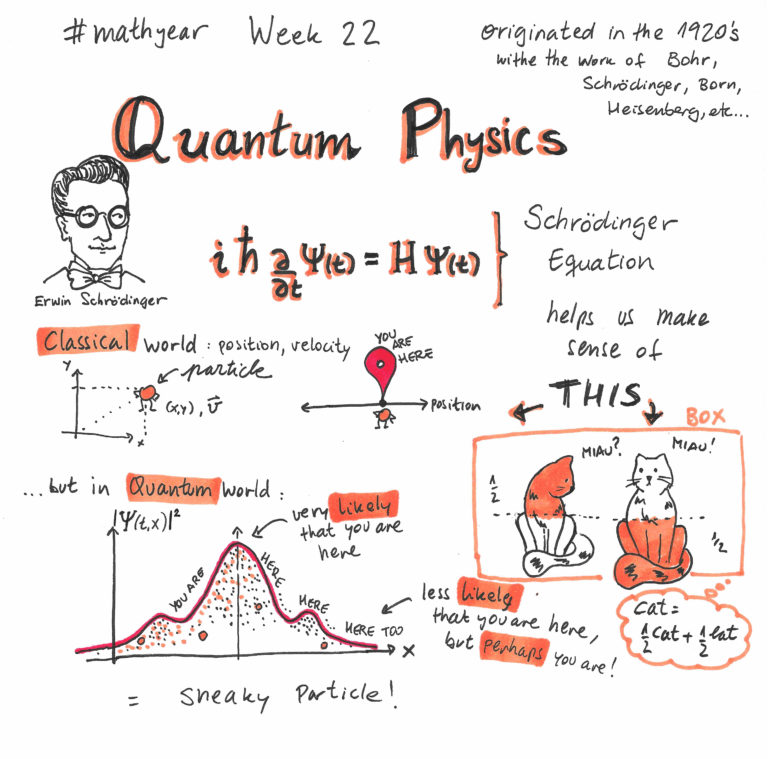
It’s an exercise of perseverance, and I’m still working on combining these activities in a balanced way. It is hard, it is extremely rewarding, but it’s absolutely worthwhile. Drawing and doing maths seem very different activities, and the main challenge is that in our society people are not expected to have more than one specialization. For example, we look up to Leonardo da Vinci for being the embodiment of the Renaissance, with so many interests and skills, and especially, curiosity. However, nowadays, we cannot be like da Vinci, because we are expected to specialize on one thing and do that thing and excel on that thing. For some people, this works well, but for others, like me, it is just not enough. Drawing is an integral part of how my mind works and how my body functions.
At the beginning, I used to think maths and drawing were separate activities. Drawing has always been a part of my life, and I discovered maths relatively late, when I was studying at the university, and for a long time I thought I had to make a choice between one or the other. In my early work in science communication (the blog The RAGE of the Blackboard), I kept these two activities separated, I even used a pseudonym for my illustration activities. It took me years of experiences and interactions with people around me, to realize that I could try to integrate these two aspects of my identity into my work, because illustration worked well as a tool to communicate maths, so it served a purpose that is extremely important in what I do as a mathematician.
I know several people who besides doing maths, do art or have another passion, and some people manage to keep these activities separated. Maybe what makes me stand out is that I insist on bringing my two creative passions together. I’m stubborn! But if today I can be stubborn is also because I was lucky enough to have rewarding experiences and good friends who gave me good advice, and made me question my own view of the maths career. It was thanks to interactions with other people that I even started considering about combining maths and illustration.
 May 12 marks the International Day of Women in Mathematics, honouring Maryam Mirzakhani’s legacy. As the author of The RAGE of the Blackboard and a member of the EMS Outreach and Engagement Committee, you’ve had a privileged vantage point on the state of gender equity in the mathematical sciences. What progress do you see, and what remains the most persistent challenge?
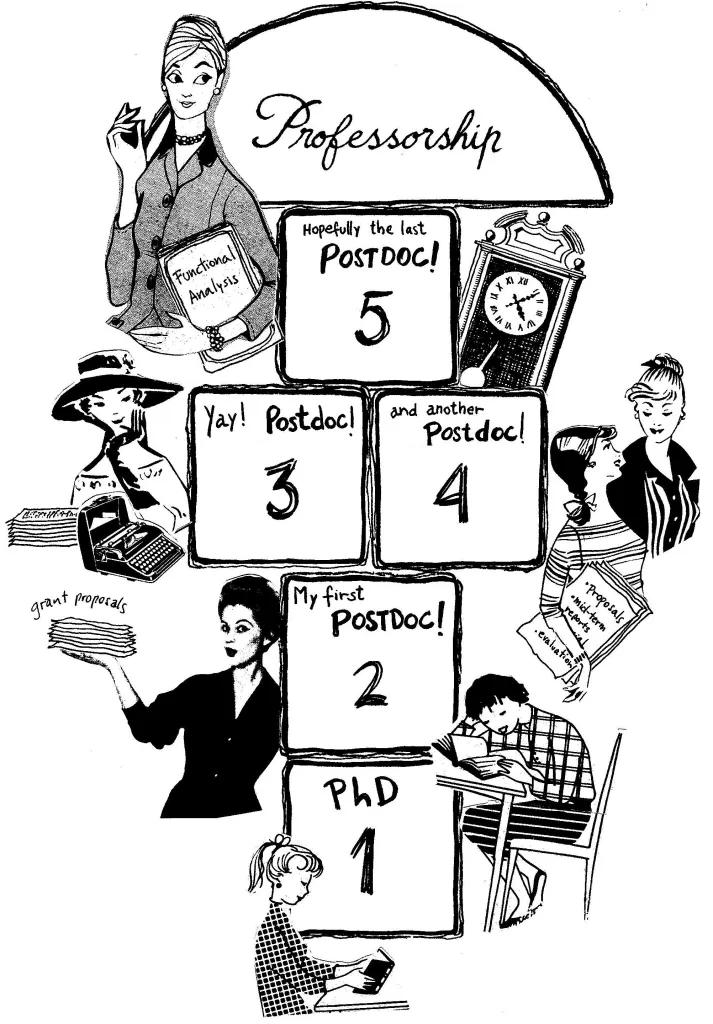
Although the numbers are still far from reflecting equal opportunities, I see some progress, and I see some of the mechanisms that facilitate this progress. I see that women organize in groups like the European Women in Mathematics Association, or the more recent Association of Women in Mathematical Physics, that I’m lucky to be part of. These associations bring women together to find support in many aspects or their professional lives, and is a support that is by women for women. Unfortunately, one finds a lot of policies and measures that are only about checking-boxes, without showing any interest in a deep understanding of the challenges women face in mathematics.
Sometimes, one comment, one bad experience can change someone’s life, making them leave maths. In the same way, one good experience, maybe the right advice and the right time can be life changing and make you take the next big step that will be the beginning of a fulfilling career in maths. We need to make the space for this latter scenario to hapen in abundance. Having a strong community is a way to do this, to secure a true and honest support, with empathy and generosity. This is the terrain every person needs to flourish. I celebrate the many initiatives that are done at the level of countries, like Femmes et maths, in France, or EWM-Netherlands, to give an example. I am optimistic, and at the same time I think the efforts to build such a nourrishing environment need to be permanent and be renewe, because it is not something that will change from one decade to the next. It should be internalized.
There are still many problems in the academic environment, that I think are systemic and require more profound changes. The leaky pipeline, as we call the fact that women leave careers in mathematics, is only one visible manifestation of deep features of the academic system. There are more groups that are marginalized, and we need to be aware of this. We need policy changes, but, I insist, we need well-designed policies, not just checking-boxes. This will come when the people that build policies understand the problem truly and get serious about it. The change we need involves our male colleagues, but not only, it involves also our female colleagues, or non binary colleagues, the regular people, and the people at the top. It involves the whole society!
 You created #Noethember, a drawing challenge dedicated to Emmy Noether. What makes visual storytelling – rather than, say, a biography or a lecture – an effective way to bring historical women mathematicians closer to a wider audience?
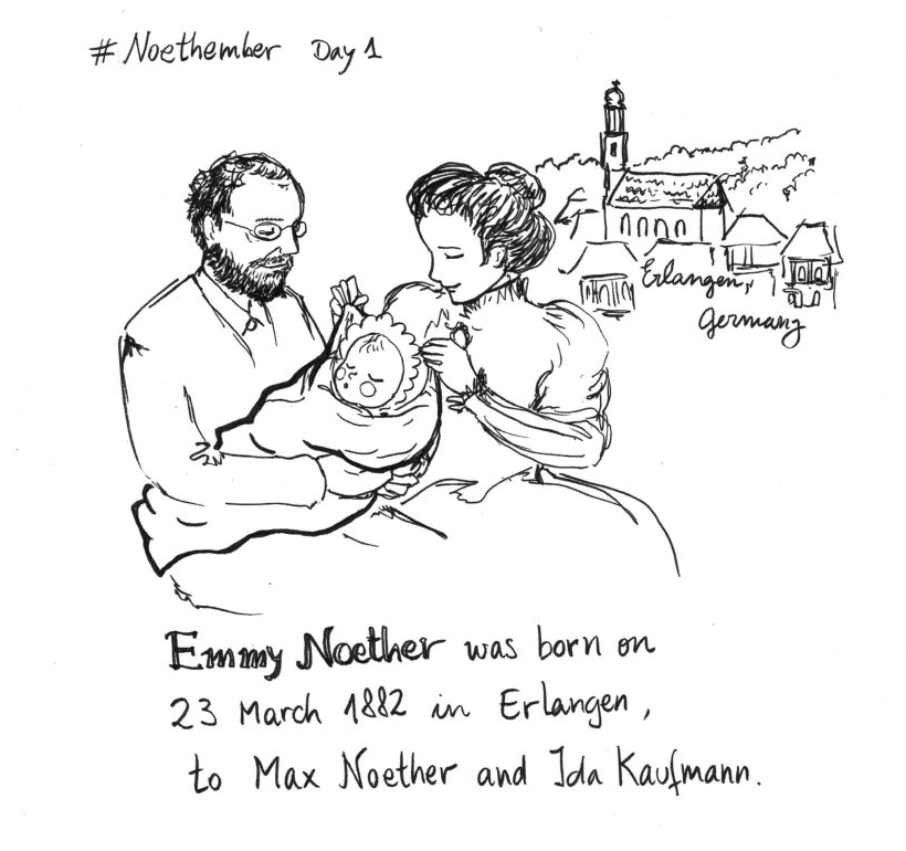
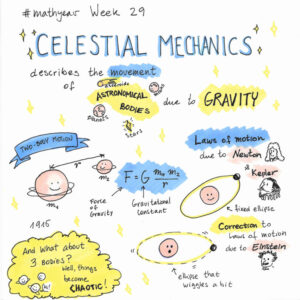
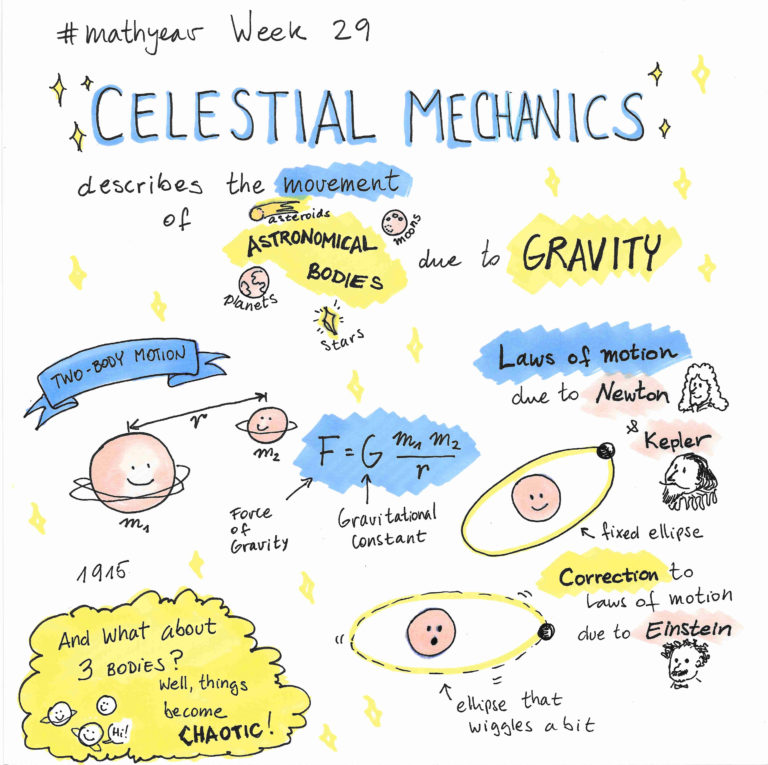
On one hand, I believe that visual storytelling is a rather universal language. We are in contact with pictures before learning words, with illustrated books before reading long texts. Interpreting images is a skill that we train from very early on and is all around us. In particular, we don’t need to know maths to understand a drawing, to feel something, good or bad, from seeing an illustration. While maths can be intimidating, pictures can feel familiar, and I think it’s the combination of these two contrasts that makes visual storytelling a powerful tool to communicate. Communication is a two-way process, and the familiarity that I seek with the drawings is a way to make the other person more open to receive the message, that then I hope will evoke something in then, to give a response in return. On the other hand, I’ve realized the profound effect that the act of drawing has on me, on my ability to process information, and in my way to familiarize myself with abstract notions. As a tool is very powerful not only to communicate, but to transform the person that is communicating.
Making illustrations about women in mathematics, in particular, contributes to a collective imagery of these characters, so that they feel more familiar to the audience. I think that to establish that feeling is key, and hopefully, in the process the audience can get to see more into the human experience of doing mathematics.
 La misteriosa conjetura de Alicia, your comic with Alberto Mercado, wraps a real mathematical problem in a fictional narrative. How did you negotiate the balance between narrative flow and mathematical precision – and what was the biggest creative challenge? Will it ever be available in English or even Italian?
Alberto (Beto) Mercado has the credit for the great narrative int his comic. He is an experienced mathematician and writer, and first wrote this story as a theater play, which then asked me to adapt into comic format. In general, the most challenging part of a comic is to have a good story, and that was already taken care of by Beto in his original text. When I teamed up with him, the most challening part was adapting the original text to a comic script. We worked for two years to write the script, going back and forth between his text and my storyboards. I worked on the storyboard and in parallel took some courses on script writing and storytelling, in order to better understand the narrative structure of the comic. All that to appreciate even more the fine job Alberto had done crafting the story.
Now, the script is a document that takes that story and splits the action into different pictures, that make the panels of the comic, and contains all the instructions for the person who is going to draw. To get to that point, I took the original text, visualized the splitting of the actions and drew the storyboard so that I could test the flow of the story. Doing that I had many comments and questions about the story, and Beto was very generous in that he allowed me to contribute to the creation process by taking into account my questions and incorporated suggestions about the flow of the story, so in the end it was a co-creation exercise to write the script together, and it was a great and formative experience. It is very important to me to be able to participate in the creation of the comic, because I am not an illustrator that will follow blindly the instructions of someone else. Sometimes I have strong opinions on things, and I am aware that I am in a priviledge position where I can select the projects I work on, to make sure I will have a say in the final outcome.
The comic appeared originally in Spanish, and then my colleagues from Université d’Angers, Clotilde Fermanian and Nicolas Raymond helped me to translated it and to get the funding to have a first French version published. So, the comic currently exists in Spanish and in French, and is free for downloading from my website. Anyone can download it, print it and distribute it. Will it ever be available in English and Italian, that depends on who would like to translate it. If somebody would be interested on doing it, I’ll be happy to provide all the files needed to have an Italian or English version!
Let me add, I recently got funding from CNRS, the French National Research Council, to prepare an activity book to accompany the comic La misteriosa conjetura de Alicia. The goal is to explore the comic’s potential as a tool for the classroom. For this project I’ll team up with high-school teachers to create activities that are adapted to the teachers and students needs. I see this also as an opportunity to see more of the characters in the comic, as I miss drawing them!
 At Comics&Science we use comics as a medium for talking about science. From your experience, what are the biggest misconceptions people still have about graphic narrative as a legitimate tool for science communication?
I think it is seeing comics as something for kids, or that is not serious enough, and definitely not “scholarly” enough. I believe this is both a misconception and its strongest advantage. People are not intimidated by childish things, so they won’t be intimidated by comics, and if it’s about mathematics, well, it’s still a comic. It cannot be as hard as proper maths, right? It cannot be that serious… Well, turns out that comics and any other kind of graphic narrative has the power to get into your head and make you imagine things, see things, and get to know things. It is an old trick, mixing text and pictures depicting actions that unfold into a story. Think of the Bayeux tapestry, telling a story about a conquest of foreing land with embroidered pictures and texts, or the old religious paintings and tryptics from middle ages or renaisance with text appearing into the landscapes and actions.
I think that the combination of drawings, narrative and written language (text) gives such a flexibility and richness that we have not yet exhausted all the posibilities for innovation with this format. Think of Nick Sousani’s Unflattening, a famous PhD thesis in humanities about comics in comic format, or the recent PhD thesis by bioinformatician and illustrator Alitzel Lopez Sanchez from the University of Sherbrook in Canada, who wrote her PhD thesis in bioinformatics in comic format, which, to my understanding, is a first in STEM disciplines. So, thinking that comics are not serious or not scholarly enough is indeed a misconception. It is a complex format that engages visual and written language, that presents many possibilities for communication, many of them still to be discovered.
In summary, you can do many things with comics, be silly, be childish, be serious, be rigorous. All these aspects are not mutually exclusive. After all, you need to keep the creativity of a child to do science, you need to be willing to explore, to imagine, to question, to get rid of filters, to take risks, to be willing to be silly from time to time. That’s all part of the job, so embrace it, and what better way to do it that with comics!
 You’ve described your own path as a kind of adventure. Academia often rewards linear careers, yet yours has been anything but. What advice would you give to anyone who feels their journey doesn’t follow the “expected” route?
As you well point out, academia “rewards” linear careers, but if you have not had a linear path then probably, deep down, it’s also because you are not so interested in academic rewards. You might be persuaded that you are, but look again, look deep down, are you really?
In my experience, having an out-of-the-ordinary path can be a very rich human experience, one with a lot of learning and deep relationships, including good and bad moments. With a non standard path there is much less stability and more risk, and this can be very hard. I am very grateful that I have had a loving family and friends that gave me the stability and love I needed to follow this kind of path. In different circumstances I wouldn’t have done it. So, if I can give any advice, would be to have a good support network. Find the people with whom you feel comfortable and that bring out the best in you. You will need them.
There were a couple of moments in my career where I seriously considered leaving academia, and worked on a plan B. I ended up staying in academia, but I think it is always wise to have a plan B. At least, it was helpful for me, to think of all my skills, to reflect on how I could use them to do other jobs. Academia is not the only place where you can have a fulfilling career. And for this, it is crucial to really know what makes you happy, and knowing what you are willing to compromise is also very important. Talking about this with your closest relationships can be very helpful to understand that.
And finally, on this International Day of Women in Mathematics: is there something you wish someone had told you when you were a young woman just starting out in maths – something you’d like to pass on to the next generation?
Oh, so many things! And knowing myself it probably wouldn’t make a difference, because I would have had to make my own mistakes to learn things on my own, stubborn as I was. Joke aside, I would tell that young woman that success is a lot of luck, not just hard work, so to not take her failures too personally, or as lack of talent. I would tell her to take the path that aligns with her values, to be honest with herself. We have a job where professional decisions and personal decisions are often intertwined, and when we make decisions that are against our gut is often because they do not align with our values, with what we care about. To know what is that we care about, what we love, is extremely important. Careers have ups and downs, but our values and our aspirations remain with us. Often in interviews people ask you, where do you see yourself in 5, or 10 years from now. That’s actually a very good question. Think of what kind of old lady you would like to be.
I would also tell that young women to not be ashamed of taking out her sketchbook to draw in public spaces. I would tell her to speak out earlier or more often, because the people that really matter, that she cares about, will stand by her.
Also, get a planner.

May 12, 2026: Celebrating Women in Mathematics in Italy and Worldwide
The International Day of Women in Mathematics is celebrated across Italy with events organised by universities, departments, and mathematical associations. Here is a selection of initiatives for 2026.
MaddMaths! and the University of Pisa are organising Educazione Matematica e Questioni di Genere, a training afternoon for primary school teachers on gender issues in mathematics education (Pisa, May 26).
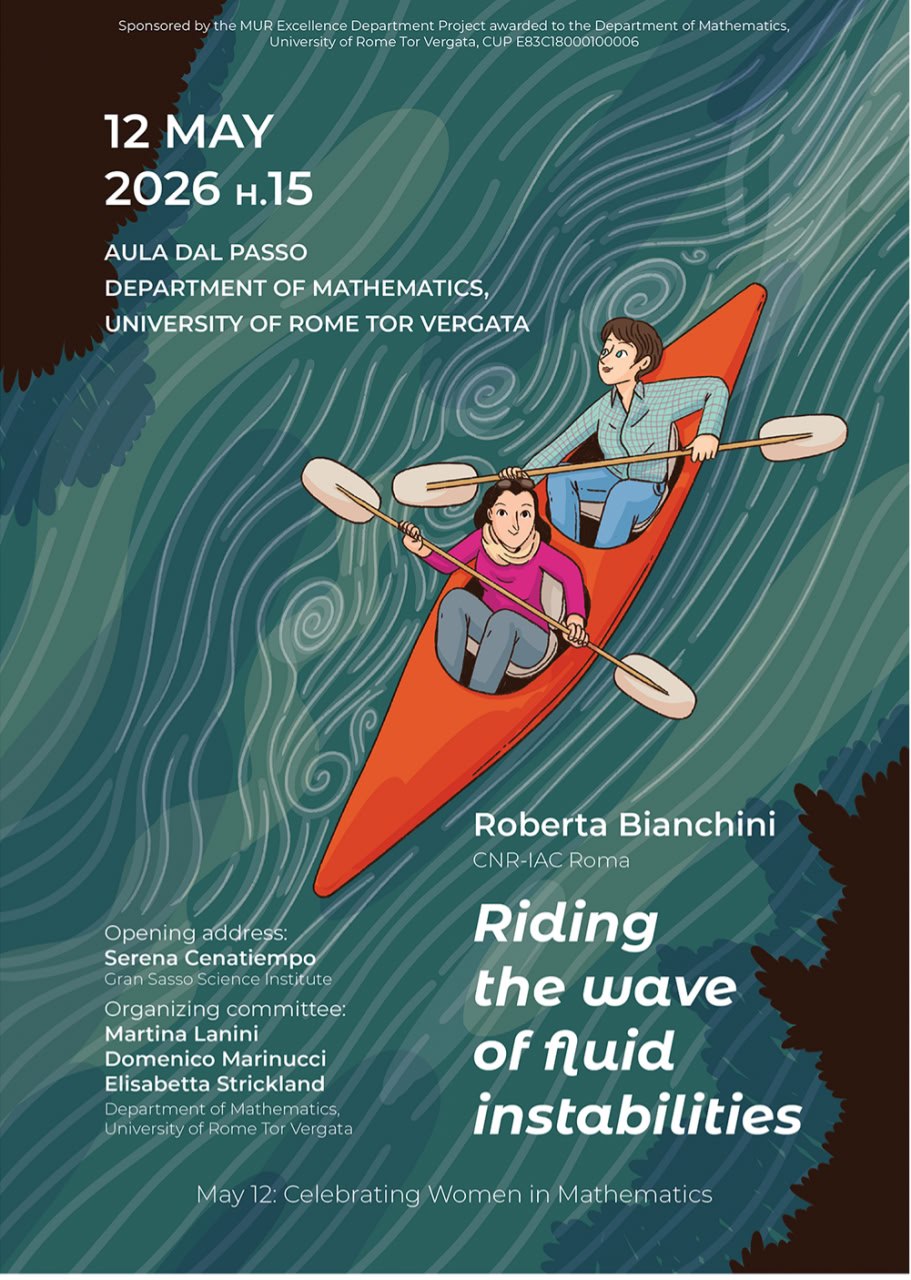
At the University of Rome Tor Vergata, the celebration features a talk titled Riding the wave of fluid instabilities by Roberta Bianchini (CNR-IAC) and an opening address on Maryam Mirzakhani by Serena Cenatiempo (Gran Sasso Science Institute). The event poster was illustrated by Claudia Flandoli and depicts mathematician Cristiana De Filippis in an ideal dialogue with Mirzakhani (Rome, May 12).
The full list of Italian and worldwide events is available on the May 12 website.